THE MIND

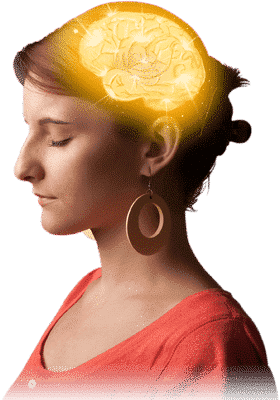
To understand how the MINDCODE method works it’s useful to have an understanding of the basic workings of the human mind. We have one mind, however our mind works on two levels; the conscious and the unconscious.

The unconscious mind is the automatic mind and is programmed from birth to respond automatically to the world, in five ways; through repetition, through peak emotional experiences, direction from authority such as parents and teachers, a desire for identity and through our imagination.

You can think of the unconscious mind as the automatic pilot of the mind. It runs all the things we don’t need to think about, including our breathing, heartbeat and immune system, as well as our automatic emotions and our habits, both good and bad habits. The right-brain left-brain model in psychology suggests that the right side of the brain is the seat of the unconscious mind.

And we also have a conscious mind. It is the part of the mind where we tend to live. It is whatever we are aware of in any given moment. We think, we make decisions, and we are motivated to act on those decisions with our conscious minds. It is suggested that the left side of the brain is the seat of the conscious mind.

Both levels of mind are contributing their part to the smoking habit and so to stop smoking permanently both levels of mind must be attended to. Each level of our mind has a different mind language, a different code, if you will. And this is the basis of the MINDCODE approach. It is a whole-mind approach to stopping smoking.

THE HABIT

The unconscious mind is the automatic mind. It is where the associations to smoking are stored and from where the craving to smoke is generated. Smokers feel they NEED to smoke because they have physical unconscious urges or cravings. The craving to smoke is what prevents most smokers, that really want to stop smoking, from being able to do so easily.

The conscious mind is the thinking mind. It is where a smoker’s perception of smoking is held, the belief that smoking is enjoyable and that there is some kind of benefit to it, and is from where the motivation, or WANT to smoke, is generated.

Another way to describe this, which is quite easy to relate to, is that when a teenager starts smoking they don’t yet have a craving or NEED to smoke. And that is because the smoking habit has not yet been trained in at the unconscious level of mind.

What a teenager does have when they start smoking, is a very strong conscious motivation or WANT to smoke, based on beliefs, among others, that smoking is cool and that they will be cool if they smoke. And that motivation is so strong that they force themselves through the unpleasant experience of starting smoking.

And so smokers that have smoked for some time have both an unconscious NEED to smoke, based on cravings that have been trained in over time, as well as a conscious motivation or WANT to smoke, based on beliefs that smoking is enjoyable or beneficial in some way.

In order to stop smoking permanently one has to change one’s unconscious habit of smoking, and the resulting craving, as well as one’s positive perception of smoking, and the resulting motivation to smoke. When a person that has successfully stopped smoking relapses after some time, it is a result of a conscious decision to smoke again, because they had not yet completely changed their perception that smoking is enjoyable or beneficial in some way.


FAQ

Is nicotine a drug like heroin?

Nicotine is a plant poison. Most plants have poisons as protection against foreign insects. The plants we eat do; almonds have arsenic and potatoes have nightshade. Some plant poisons are psychoactive, meaning they’re drugs. A psychoactive plant poison changes a person’s emotional state and their perception. Nicotine doesn’t do either and it’s the reason that people are able to smoke cigarettes and still go to work, because they’re not high!

Humans have been aware of and used the known psychoactive plant poisons like marijuana, cocaine from the cocoa leaf and heroin from the poppy flower for thousands of years. And nicotine has never been sold on the street as a drug. Nobody would buy it, because you can’t get high from it. In fact it is quite unpleasant to consume nicotine. If a non-smoker, without a tolerance to nicotine, were to use a nicotine patch, within a short period of time they would experience the side effects of poisoning, including elevated heart rate, nausea and anxiety.

What are the effects of nicotine?
Nicotine is three times more toxic than the plant poison arsenic. When it is inhaled it creates a shock to the body and the fight or flight response is instantly stimulated and adrenaline is released into the blood. Vapers, that are inhaling a higher dose of nicotine, will recognise the adrenal response as the “hit” they get. Nicotine can therefore be considered a stimulant similar to the plant poison caffeine. Nicotine and caffeine are both classed as alkaloid poisons and therefore carry the “-ine” suffix.

When nicotine is first inhaled it can cause nausea, anxiety, headache, increased heart rate and sweaty palms, which are symptoms of poisoning. Over time a smoker gradually builds a tolerance and they no longer experience the poisoning symptoms, only the adrenal response. Heavy smokers, that smoke 40 to 60 cigarettes a day, may eventually experience adrenal fatigue and will no longer experience the adrenal response due to exhaustion of the adrenal glands.

Is smoking really a habit?
It has been proven since 2002 that smoking is a compulsive behaviour, similar to a compulsion to gamble. If a gambler were to try and stop gambling they would experience what a smoker does, apart from a 3-day nicotine detox, of course. A gambler would experience physical cravings that last 3 to 5 minutes. And if they were to continue to restrict themselves they might feel irritable and experience mood swings.

Most compulsive behaviours express a physical craving, including “addictions” to watching television and playing internet games. Almost any behaviour that is repeated consistently, where there is also an anticipation of a reward, will eventually develop a physical craving.

Prior to 1993 the definition of compulsive behaviours was distinct from the definition of addictions. The word addiction used to refer to a substance dependency. Now the word addiction applies to any behaviour that is repetitive in nature over which we feel we don’t have control.

What is a craving?
The unconscious mind is the automatic mind and one of the ways that it learns is through repetition. If a behaviour is repeated consistently enough, like driving a car, and there is also an anticipation of a reward from the behaviour, then an unconscious craving is generated at those times that the behaviour is repeated in the past.

The reason most of us don’t have a craving for driving a car, is because there wasn’t that anticipation of a reward from driving when we learned to drive, that there was from smoking when we learned to smoke.

An unconscious craving is a physical sensation in the abdomen. It can be described as an empty feeling that needs to be filled. It is often referred to as a physical urge to do something. It usually lasts 3 to 5 minutes and if one is distracted by something else, it simply disappears.

Will I experience withdrawal symptoms?
When a smoker attempts to stop smoking they describe a number of side effects collectively known as withdrawal symptoms. The term withdrawal symptom is misleading since nicotine is not a drug. Typically a heroin addict, that is physically addicted, experiences withdrawals.

Smoking “withdrawal symptoms” are a combination of detox symptoms, conscious thoughts of smoking and unconscious cravings. The extent to which a smoker experiences one or all of these varies from person to person. The MINDCODE method is designed to address all three of these “symptoms” related to stopping smoking.

Most smokers that stop smoking experience a 3-day nicotine detox. The detox can include symptoms of anxiety. Fortunately, with MINDCODE the detox effect can be overridden or drastically reduced. And the breath-work that is included in the program assists in alleviating anxiety.

What if I relapse?
When a person that has successfully stopped smoking relapses after some time, it is a result of a conscious decision to smoke a cigarette again, because they had not yet completely changed their belief that smoking is enjoyable or beneficial, that it might help them, for instance, cope through a challenging situation or relieve their stress.

The person may have stopped smoking for months or even years, and really enjoyed the benefits of being free from smoking, but if at the time they stopped smoking, they believed that a cigarette relieved stress, that could be the reason for a relapse in the future.

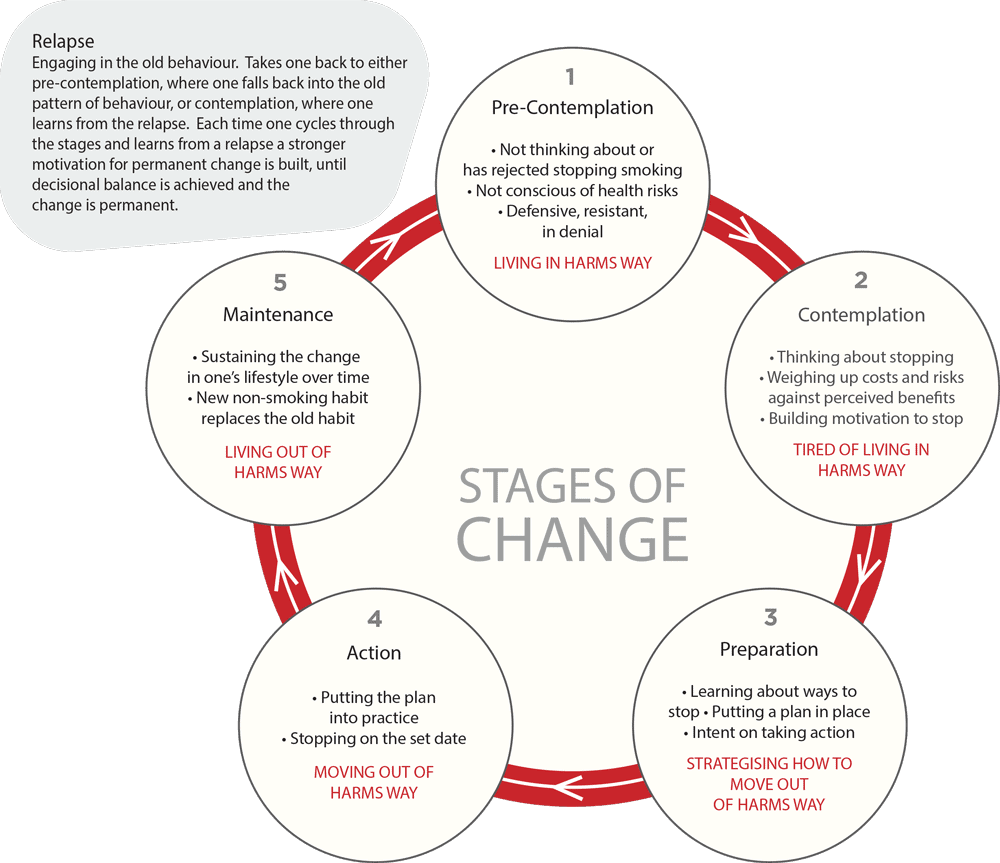
Relapse is one of the stages that a person goes through on the journey to stopping smoking permanently. The experience can be used to convince oneself that being free from smoking and living a healthier life is a far better way to live.

ABOUT US

Craig Evans, the principal of the MINDCODE practice, initially began helping his clients quit their smoking habit primarily using hypnosis.

Over time Craig noticed a corresponding pattern with clients that struggled with thoughts of smoking after their hypnosis session and those that relapsed after some time. Many of those same clients experienced no physical withdrawal symptoms.

A search for an answer through the literature ensued. A number of books and articles provided pieces to the puzzle, but there were pieces to the smoking puzzle that were either missing or didn’t make sense.

And so through a number of years of feedback from clients, as well as continued reading through various fields, Craig discovered the missing pieces of the smoking puzzle. And the MINDCODE method evolved into the highly effective program it is.

Craig is a licensed Master Practitioner of Neuro-Linguistic Programming (NLP) and Ericksonian Hypnosis and is an expert in the area of smoking cessation. He completed his NLP training in London with Dr Richard Bandler, the founder of NLP, and is a member of the Society of Neuro-Linguistic Programming.

Craig furthered his studies in the application of NLP and hypnosis to smoking cessation through Clinical Hypnotherapist and trainer, David Botsford, also based in London. David developed a very successful smoking cessation method that consistently delivers results within one session.

Craig also received certification in the South African Institute of Hypnosis (SAIH) smoking cessation method, and has received training in the hypnotherapy technique of Parts Therapy. Craig is certified as a Parts Therapy Facilitator with the Charles Tebbetts Foundation, in the USA.
Craig Evans

MINDCODE PRINCIPLE

Craig Evans

MINDCODE
PRINCIPLE

Craig Evans

MINDCODE PRINCIPLE

CLIENT REVIEWS

COST

Below is a table indicating the amount you may be spending on cigarettes. The table doesn’t consider the increasing costs of cigarettes, or the costs of smoking-related illnesses, premium medical care, or days off as a consequence of smoking. Consider also that when you stop smoking, according the World Health Organisation, you will add an estimated 3 to 10 years to your life!
Cigarettes Per Day
1 day
1 Month
3 Months
10
R12
R23
R360
R690
R1,080
R2,070
20
R24
R46
R720
R1,380
R2,160
R4,140
30
R36
R69
R1,080
R2,070
R3,240
R6,210

* Least costly and most costly cigarettes averaged from 5 stores

Investment or Expense? Being freed from the habit of smoking is an investment in one’s health and wellbeing for the rest of one’s life. And on average the investment pays for itself within six weeks from savings of money you used to spend on cigarettes! And if you choose our PAYFLEX payment option you can PAY IN 3 EASY INSTALLMENTS OVER 3 MONTH-ENDS with no additional fees!

Online Session

R2450 R1950

EARLY-BIRD PROMO!

  • Four-and-half hour Online session
  • Telephonic support for 28 days

HOW IT WORKS

In-Person Session

R2450 R1950

EARLY-BIRD PROMO!

  • Four hour In-person session
  • Telephonic support for 28 days

HOW IT WORKS

Online Session

R2450 R1950

EARLY-BIRD PROMO!

  • Four-and-half hour Online session
  • Telephonic support for 28 days

In-Person Session

R2450 R1950

EARLY-BIRD PROMO!

  • Four hour In-person session
  • Telephonic support for 28 days

BOOKING

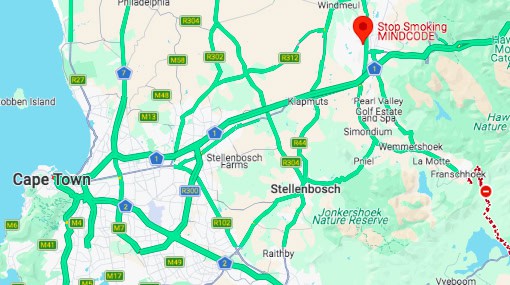
PLEASE NOTE: We have moved from Hout Bay to Paarl

ONLINE

R2450 R1950

EARLY-BIRD PROMO!

IN-PERSON

R2450 R1950

EARLY-BIRD PROMO!

CONTACT

PLEASE NOTE: We have moved from Hout Bay to Paarl

If you would like to go ahead and book your session to stop smoking, please feel comfortable using our Booking page. We have the PayFast, Payflex and Snapscan gateways available.

If you have any questions before making your booking, we will be happy to chat with you. We look forward to helping you become free of your smoking habit.

NEW ADDRESS
7 Van der Poelsdoordrift Street
Paarl
Western Cape

Contact Email
info@stopsmokingmindcode.co.za

OLD ADDRESS
4316 Hout Bay Road
Hout Bay
Cape Town

Contact Telephone
076 983 6384

If you would like to go ahead and book your session to stop smoking, please feel comfortable using our Booking page. We have the PayFast, Payflex and Snapscan gateways available.

If you have any questions before making your booking, we will be happy to chat with you. We look forward to helping you become free of your smoking habit.

OPEN TIMES
Monday to Friday: 9am – 5pm
Saturday: 9am – 1pm

CONTACT DETAILS

076 983 6384
NEW ADDRESS
7 vd Poelsdoordrift St
Paarl
Western Cape

OLD ADDRESS
4316 Hout Bay Road
Hout Bay
Cape Town

    If you would like to learn more about hypnosis and NLP and how it can be applied to smoking-cessation and also what the requirements for success are, you are welcome to visit the Hypno-smoking website for more information  – and if you have any questions feel free to reach out

    Our BLOG is under construction and will contain the videos and tools to assist you through the MINDCODE program

    Designed by Wooosh | © 2026 Mindcode